Updated 2026-09-11
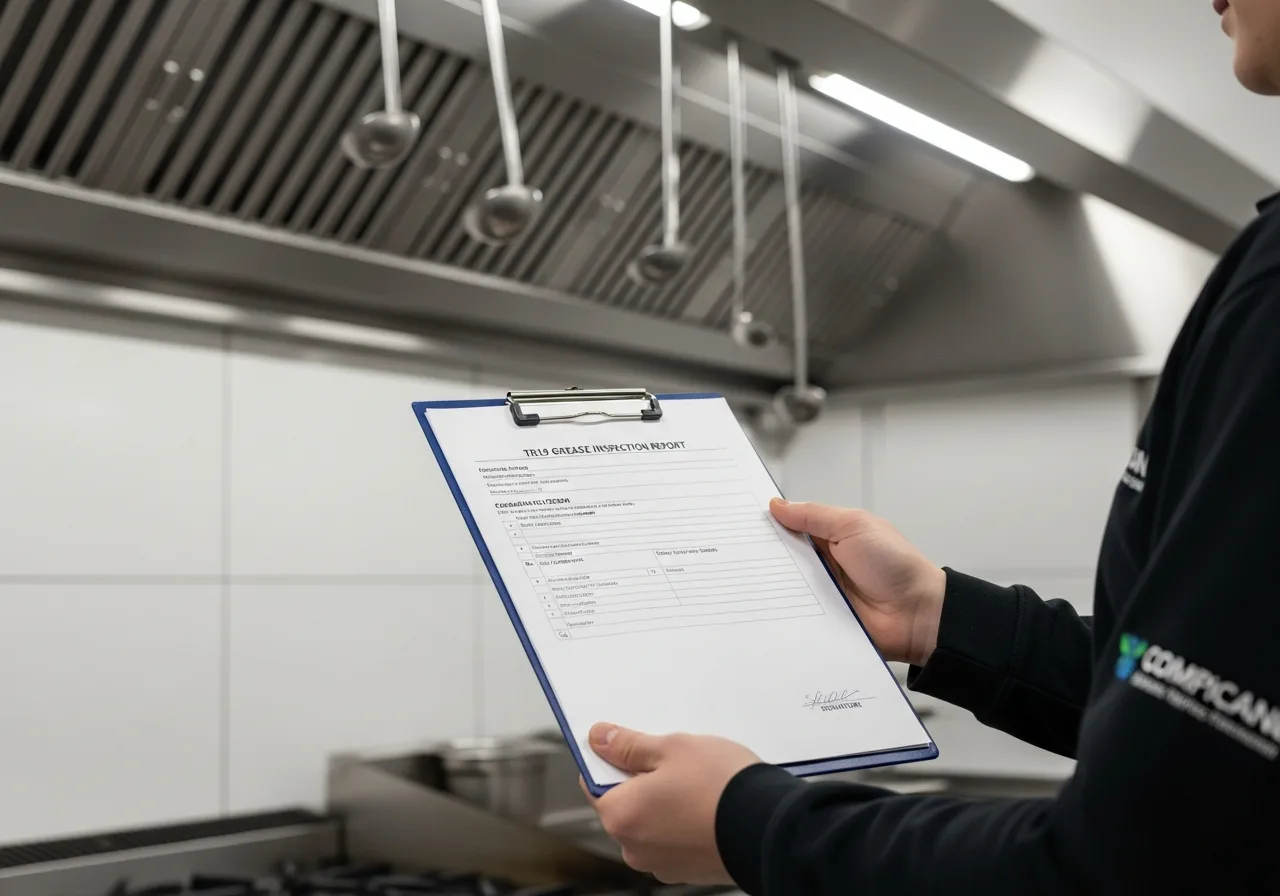
There is no single law called the kitchen extract cleaning regulations, and no statute that states an interval in months. What the law does is place duties on the people who run food premises: to assess and control fire risk, to keep the premises and its ventilation clean, to protect employees, and to keep records. TR19 Grease, the BESA specification, is how those general duties are turned into a measurable standard. This guide sets out the legal framework in each part of the UK, and the TR19 regulations guide explains how the specification fits into it.
Fire safety law
England and Wales. The Regulatory Reform (Fire Safety) Order 2005 applies to virtually all non-domestic premises. It makes the "responsible person", usually the employer or the person in control of the premises, accountable for carrying out a suitable and sufficient fire risk assessment (Article 9), taking general fire precautions, and maintaining facilities and equipment provided for fire safety in an efficient state and good repair (Article 17). A grease-laden extract is a fire hazard the assessment must identify, and a cleaning regime is the expected control. Fire and rescue authorities enforce the Order through inspection, enforcement notices and prohibition notices; serious offences carry unlimited fines and up to two years' imprisonment on indictment.
Scotland. Part 3 of the Fire (Scotland) Act 2005 and the Fire Safety (Scotland) Regulations 2006 impose equivalent duties on the "duty holder", including a fire risk assessment and the maintenance of fire safety measures. The Scottish Fire and Rescue Service enforces them.
Northern Ireland. The Fire and Rescue Services (Northern Ireland) Order 2006 and the Fire Safety Regulations (Northern Ireland) 2010 follow the same model, enforced by the Northern Ireland Fire and Rescue Service.
Food hygiene law
The Food Safety Act 1990 is the parent statute. The operative rules are the Food Safety and Hygiene (England) Regulations 2013, the Food Hygiene (Wales) Regulations 2006, the Food Hygiene (Scotland) Regulations 2006 and the equivalent Northern Ireland regulations, all of which give effect to the retained Regulation (EC) 852/2004 on the hygiene of foodstuffs. Annex II, Chapter I of that regulation requires food premises to be kept clean and in good repair, to have suitable and sufficient means of natural or mechanical ventilation, and for ventilation systems to be constructed so that filters and other parts needing cleaning or replacement are readily accessible. Local authority environmental health officers enforce these rules and can serve hygiene improvement notices; the EHO inspections guide describes how the extract is assessed.
Workplace health and safety
The Health and Safety at Work etc. Act 1974 requires employers to protect employees and others from risks arising from the business, and a duct fire is such a risk. Regulation 6 of the Workplace (Health, Safety and Welfare) Regulations 1992 requires effective ventilation in enclosed workplaces. Where a kitchen extract system is relied on to control employees' exposure to cooking fumes, it may fall within the definition of local exhaust ventilation under the Control of Substances Hazardous to Health Regulations 2002, and Regulation 9 then requires a thorough examination and test at least every fourteen months, with records kept for five years. Whether a given canopy counts as LEV depends on what it is there to do; a competent health and safety adviser can confirm the position for your kitchen.
Summary of the legal framework
| Law | Where | Duty relevant to extract cleaning | Enforced by |
|---|---|---|---|
| Regulatory Reform (Fire Safety) Order 2005 | England and Wales | Fire risk assessment; maintain fire safety measures | Fire and rescue authorities |
| Fire (Scotland) Act 2005; Fire Safety (Scotland) Regulations 2006 | Scotland | Same duties on the duty holder | Scottish Fire and Rescue Service |
| Food Safety Act 1990 and the food hygiene regulations | UK-wide, by nation | Premises and ventilation kept clean; parts needing cleaning accessible | Local authority environmental health |
| Health and Safety at Work etc. Act 1974; Workplace Regulations 1992 | Great Britain | General duty of care; effective ventilation | HSE and local authorities |
| COSHH Regulations 2002, Regulation 9 | Great Britain | LEV examined and tested every 14 months where the extract is LEV | HSE and local authorities |
| Building Regulations and DW/172 | Design and installation | Adequate access for cleaning built into new systems | Building control |
Leases, landlords and tenants
Statute places the fire safety duty on whoever has control of the premises, which in a let unit is normally the tenant for the kitchen and its extract, and the landlord for common parts. The lease usually says so expressly and often requires the tenant to clean the extract at stated intervals and produce the certificate on demand. Where a duct passes through a landlord's riser or another tenancy, the lease may split responsibility or give the landlord a right to arrange the clean and recharge it. Read the repairing and service charge clauses before assuming the extract is someone else's problem; the fire authority will look for the person in control, not the lease.
What the law expects in practice
Put together, these duties mean a food business is expected to identify the extract as a fire risk, clean it at an interval justified by its use, using a competent contractor, and keep the evidence. The frequency bands of TR19 Grease supply the interval: every three months for heavy use at twelve to sixteen cooking hours a day, six months for moderate use, twelve months for light use. The post-clean report supplies the evidence. Your insurer will expect exactly the same documents; the insurance requirements guide explains why.
Meeting the duty
Extract Cleaning UK does not offer legal advice and does not carry out the work. We arrange TR19 cleans through vetted contractors across England and Scotland, and through our three local sites in Wales, so that the responsible person has a competent specialist, a schedule and a report to point to. Describe your kitchen to us and we will arrange a quote that fits the interval the law and your insurer expect.
Read next: Post-Clean Report · EHO Inspections · Grease Fire Risk
Frequently asked questions
Is there a law that says how often kitchen extract must be cleaned?
No. Fire safety law requires the responsible person to assess and control fire risk, and food hygiene law requires ventilation to be kept clean, but neither states a number of months. The intervals come from TR19 Grease, which enforcing authorities and insurers use to judge whether the legal duty has been met. In that sense the TR19 interval is what the law expects, even though it is not written into it.
Who is the responsible person for a restaurant's extract system?
Under the Fire Safety Order it is the person with control of the premises, normally the employer or operator of the restaurant, and in Scotland the equivalent duty holder. A lease can allocate the practical task to the tenant or the landlord, but the statutory duty follows control. If you run the kitchen, assume the duty is yours unless the lease and the landlord say otherwise in writing.
Can I be prosecuted if the extract catches fire?
You can, if the fire risk assessment failed to address the extract or the cleaning regime was not maintained, because both are breaches of the Fire Safety Order or its Scottish equivalent. Prosecutions following kitchen extract fires do happen, particularly where people were put at risk, and the penalties include unlimited fines and imprisonment. Records of TR19 cleaning at the correct interval are the defence.
Does COSHH apply to my kitchen canopy?
Possibly. Where the canopy is there to control employees' exposure to fumes it may be treated as local exhaust ventilation, and COSHH Regulation 9 then requires a thorough examination and test at least every fourteen months by a competent person. That examination is about airflow and performance, not grease, and is separate from the TR19 clean; a health and safety adviser can confirm whether it applies to you.