Updated 2026-09-11
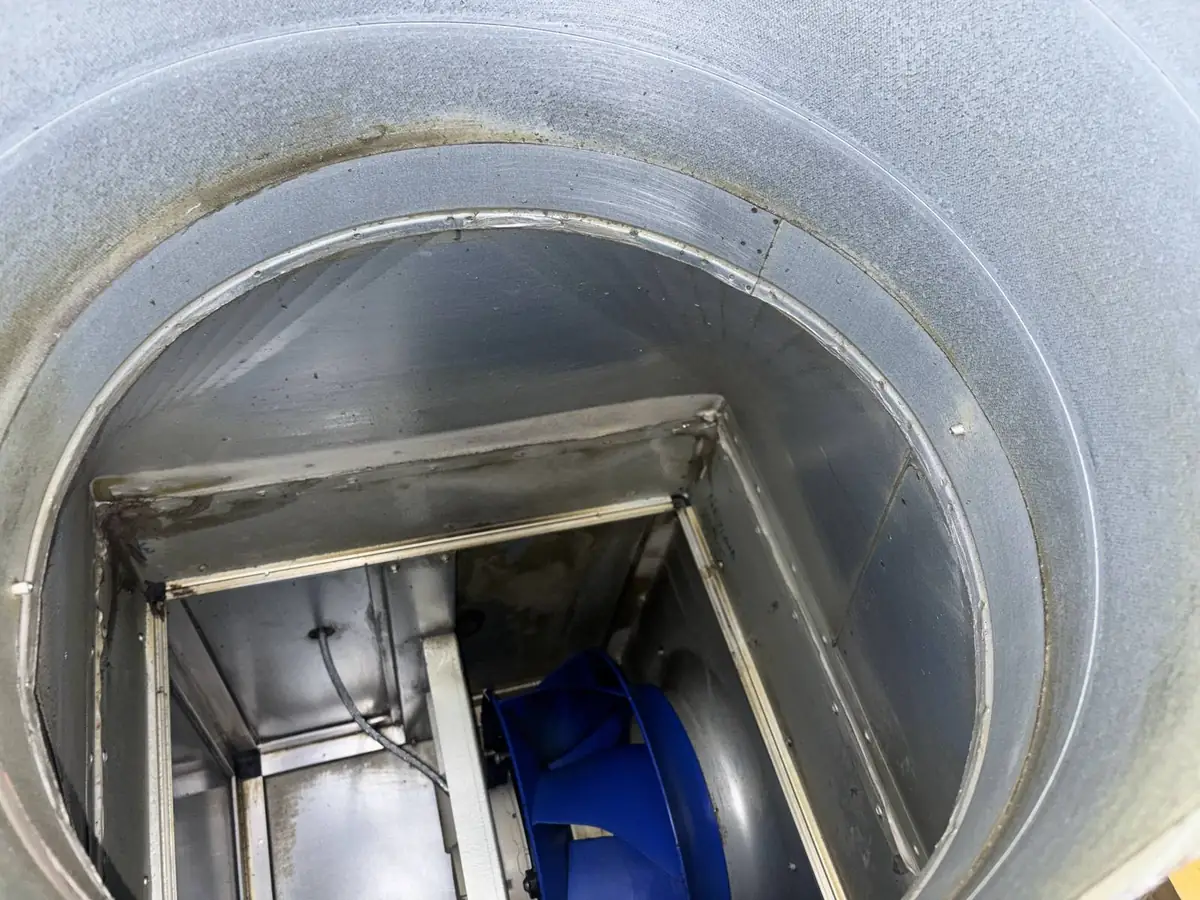
Every commercial kitchen carries a fire risk on the cooking line, and most operators manage it well: suppression over the range, extinguishers and fire blankets to hand, staff trained to deal with a pan fire. The risk that catches businesses out is the one they cannot see. Grease from cooking travels up the canopy, condenses inside the ductwork and builds into a layer of fuel that runs through the building, above ceilings and through walls, to the roof. When it ignites, the duct becomes a chimney. This guide explains how the deposit forms, what sets it alight and what stops it.
How grease builds up in ductwork
Cooking releases fat as vapour and as fine airborne droplets. The extract pulls this into the canopy, where baffle or mesh filters catch a portion, and the rest passes into the plenum and the duct. As the air moves away from the heat it cools, and the vapour condenses on the duct walls. The deposit is heaviest in the first few metres behind the canopy, at every bend and change of section where the airflow slows, and on the fan impeller, where droplets are flung against the housing. Over months it hardens into a layer that no longer drips but burns readily. TR19 Grease treats a mean deposit of 200 µm across the system as the point at which cleaning is required, and a heavy-use kitchen can reach it in three months.
What ignites it
| Ignition source | How it reaches the duct | Typical kitchens |
|---|---|---|
| Flare-up on the range | Flames drawn up through the filters into the plenum and duct | Any gas or solid-fuel kitchen, especially chargrills and wok ranges |
| Solid-fuel embers | Glowing particles carried by the airflow into the duct | Charcoal grills, wood-fired ovens, tandoors |
| Fan motor or bearing failure | Overheating motor ignites deposits on the impeller and housing | Older or poorly maintained fans, especially where grease has unbalanced the impeller |
| Hot work and heat sources | Welding or lamps near ductwork in a void or roof space | Refurbishments and roof repairs |
| Deep fat fryer fire | Oil fire produces flames tall enough to reach the canopy | Takeaways and fried-chicken outlets |
How a duct fire spreads
Once the deposit is burning, the extract fan does what it is designed to do and pulls air along the duct, feeding the fire and carrying flame and hot gases to the far end. The duct passes through the parts of the building that fire compartments are meant to protect: ceiling voids, risers, party walls and roof spaces. Grease ducts should not contain fire dampers, because grease would foul them, so design guidance relies on fire-rated duct construction instead; where a duct is old, unrated or has been altered, there is often nothing to stop the fire entering a void. Fires that begin in a takeaway extract and end in the flats above are the pattern fire and rescue services see repeatedly. The canopy suppression system, if there is one, discharges into the hood and the first section of duct; it does not protect forty metres of ductwork beyond it.
The consequences
Beyond the immediate danger to staff, customers and neighbours, a duct fire usually means the kitchen is closed for weeks while the system is stripped out and replaced, structural damage is repaired and the insurer investigates. The investigation starts with the cleaning records. Insurers commonly reduce or refuse claims where the extract was not cleaned to the policy condition, and the insurance requirements guide explains how that plays out. The fire and rescue service will also want to know whether the fire risk assessment addressed the extract, and prosecutions under the Fire Safety Order follow the worst cases.
The controls that work
| Control | What it does | Who does it |
|---|---|---|
| Filters cleaned weekly | Captures more grease before it enters the duct; a clogged filter passes more, not less | Kitchen staff, logged |
| Canopy and plenum wiped regularly | Removes the deposit closest to the flame | Kitchen staff |
| Specialist clean at the TR19 interval | Removes the fuel load from the duct, fan and discharge; three, six or twelve months by usage | Ventilation hygiene contractor |
| Access panels along the run | Makes every section reachable so no hidden pocket is left | Contractor, one-off |
| Fan maintenance | Removes the commonest ignition point and keeps airflow up | Contractor |
| Fire risk assessment | Records the extract as a hazard and the schedule as the control | Responsible person or assessor |
| Fire suppression and staff training | Deals with the range fire before it reaches the duct | Operator, suppression engineer |
Warning signs
Grease dripping from the canopy edge or filters. A visible layer inside the plenum when the filters are removed. Reduced airflow, smoke lingering in the kitchen, or a fan that has become noisy or vibrates. Staining on the ceiling along the duct route or around the discharge on the roof. A smell of hot grease from a void. Any of these means the system is overdue, whatever the calendar says, and an inspection will show how far.
After a fire
Do not run the extract again until it has been inspected; damaged fire rating, warped duct and a fouled fan can make the second fire worse than the first. Photograph everything, keep the records together for the insurer and the fire investigator, and have the system professionally assessed before it is cleaned or replaced.
Reducing the risk now
If you cannot say when the ductwork was last cleaned, the fuel load is unknown. We arrange TR19 kitchen extract cleaning and fan cleaning through vetted local contractors who remove the deposit and document the result; tell us about your kitchen and we will get a quote to you within a working day.
Read next: Choosing a Contractor · TR19 Certificate · TR19 Certificate Cost
Frequently asked questions
How quickly can grease build up to a dangerous level?
In a heavy-use kitchen cooking twelve or more hours a day over high heat, the mean deposit can approach the 200 µm cleaning trigger within three months, which is why TR19 Grease sets a quarterly interval for that band. Charcoal, wok and fryer-heavy kitchens load fastest. A light-use kitchen may take a year. The only way to know for certain is a measured reading.
Does a fire suppression system protect the ductwork?
Only the first part of it. Canopy suppression systems discharge into the hood, the plenum and typically the first section of duct, and are designed to put out a fire on the cooking appliances beneath. They do not reach along a long duct run or into the fan, so a fire that has taken hold in the ductwork is beyond them. Suppression and cleaning are complementary, not alternatives.
Why is the fan such a common ignition point?
The impeller collects grease flung out of the airstream, the deposit unbalances the blades and loads the motor, and a hot or failing motor sits inside a housing lined with fuel. Older fans with worn bearings are the classic case. Cleaning the fan at every TR19 visit removes both the deposit and the strain that causes the motor to overheat.
My duct is fire-rated. Do I still need it cleaned?
Yes. Fire-rated duct is designed to stop a fire inside it spreading to the rest of the building for a period of time; it does nothing to stop the fire starting or to protect the kitchen, the fan and the discharge. It also loses its rating if it has been altered or damaged. Cleaning removes the fuel; the fire rating only limits where the fire goes.