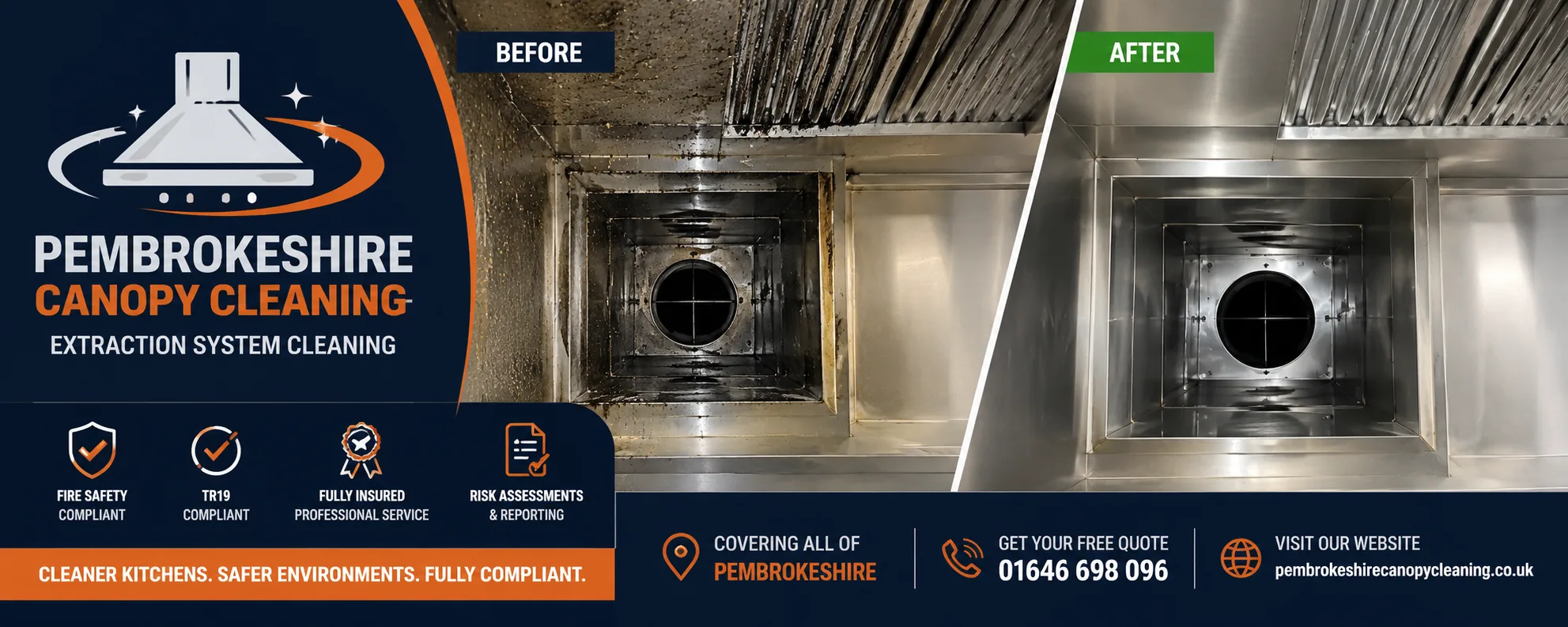
Most of the grease in a kitchen extract system is not in the canopy. It condenses in the ductwork, out of sight above the ceiling, behind the wall or up a riser, where nobody notices it until an inspection or a fire. Ductwork cleaning is the part of a TR19 Grease clean that deals with that hidden deposit, and it is the part most often skipped by anyone offering a cheap canopy wipe. When insurers and fire officers talk about kitchen extract fire risk, this is what they mean.
What a ductwork clean covers
The contractor we assign will clean the complete run from the back of the canopy to the point where the air discharges outside. That includes every straight section, bend and change in diameter, the connection into the fan housing and the discharge duct beyond it. Depending on the duct construction and the deposit, the methods used are manual scraping and degreasing, rotary brushing with extraction, and in some cases steam. The aim is bare metal, confirmed by measurement rather than appearance.
Reaching the inside of a duct requires access panels. Older systems, and many installed by kitchen fitters rather than ventilation specialists, have none, which is why an honest survey often finds that panels need to be fitted before a full clean can happen. TR19 Grease expects access at changes of direction and at regular intervals along straight runs, so that no section is left uncleaned for want of a way in. Fitting panels is a one-off cost that makes every future clean quicker and cheaper.
Measurement and thresholds
Grease depth is measured with a Wet Film Thickness Test or Deposit Thickness Test at set points along the run. The readings decide whether the duct needs cleaning and prove that it has been.
| Mean grease depth | What it means |
|---|---|
| Around 50 µm or below | Typical acceptance level after a TR19 clean |
| 50 µm to 200 µm | Deposit building; the next clean should be diarised by usage band |
| 200 µm or above | Cleaning required under TR19 Grease |
A reading is only meaningful if it is taken from inside the duct rather than the canopy, which is another reason access panels matter.
When a section cannot be cleaned
Sometimes a run passes through a fire compartment with no access, disappears into a neighbouring tenant's ceiling void, or is boxed in behind a finished wall. The specification does not allow that to be glossed over. The report must list any section that was not cleaned, state why, and show it on a schematic of the system, so that the responsible person can decide what to do about it. Insurers and loss adjusters read this section closely, because an uncleaned run is precisely where a fire starts. The post-clean report guide describes what a complete record looks like.
Long runs, risers and shared buildings
City-centre restaurants beneath flats, hotel kitchens venting through several floors and food-court units sharing a common extract all present longer and more awkward ductwork. Vertical risers in mixed-use buildings attract particular scrutiny from fire and rescue services, because a duct fire there can spread into residential floors. The contractors we work with are used to coordinating with building managers, working out of hours and fitting roof work into the job where the discharge is high up. A hotel or a city restaurant with this kind of run should mention it when enquiring so the quote reflects it.
Frequency, certificate and cost
The TR19 intervals apply to the ductwork as much as the canopy: three months for heavy-use kitchens cooking twelve hours or more a day, six for moderate use, twelve for light. On completion you receive the TR19 certificate with before-and-after photographs of each section, the grease readings and the next due date; the contractors in our network hold BESA qualifications and CHAS accreditation, are fully insured, and produce that report as standard. Ductwork is the main variable in the price of a clean, and the ductwork cleaning cost guide explains what drives it. To have a contractor survey your run and quote, send us the details.
Related services: Kitchen Extract Cleaning · Canopy Cleaning · Extractor Fan Cleaning · Filter Cleaning and Replacement
Frequently asked questions
How do I know whether my ductwork has ever been cleaned?
Look for access panels along the run and ask for the last report. If there are no panels, or the only paperwork is an invoice for a canopy clean, the duct has almost certainly not been touched. A survey with grease readings will settle it; the inspection service exists for exactly this situation and costs far less than guessing wrong.
Who pays for access panels if my landlord owns the building?
It depends on the lease. Most commercial leases make the tenant responsible for the extract system as part of the kitchen fit-out, but some landlords retain the ductwork where it serves several units. Check the repairing clause, and if the landlord's consent is needed for cutting panels, get it in writing before the visit. The contractor can supply a short specification to support the request.
Can ductwork be cleaned without turning the kitchen off?
Not safely. The fan has to be isolated so that nobody is working in a live airstream, and the cooking line beneath the canopy needs to be cold and covered. Most contractors therefore work overnight, on a closed day or during a planned shutdown. For a hotel or hospital that never closes, the work is phased kitchen by kitchen.
My duct runs through the flat upstairs. What happens?
The contractor still needs to clean it, and the report has to record the outcome either way. Access to the neighbouring premises will need to be agreed in advance, usually through the landlord or managing agent. Where access is refused, the section is recorded as uncleaned with the reason, and you should raise it with your insurer, because an unreachable run above sleeping accommodation is a serious risk.