Updated 2026-09-11
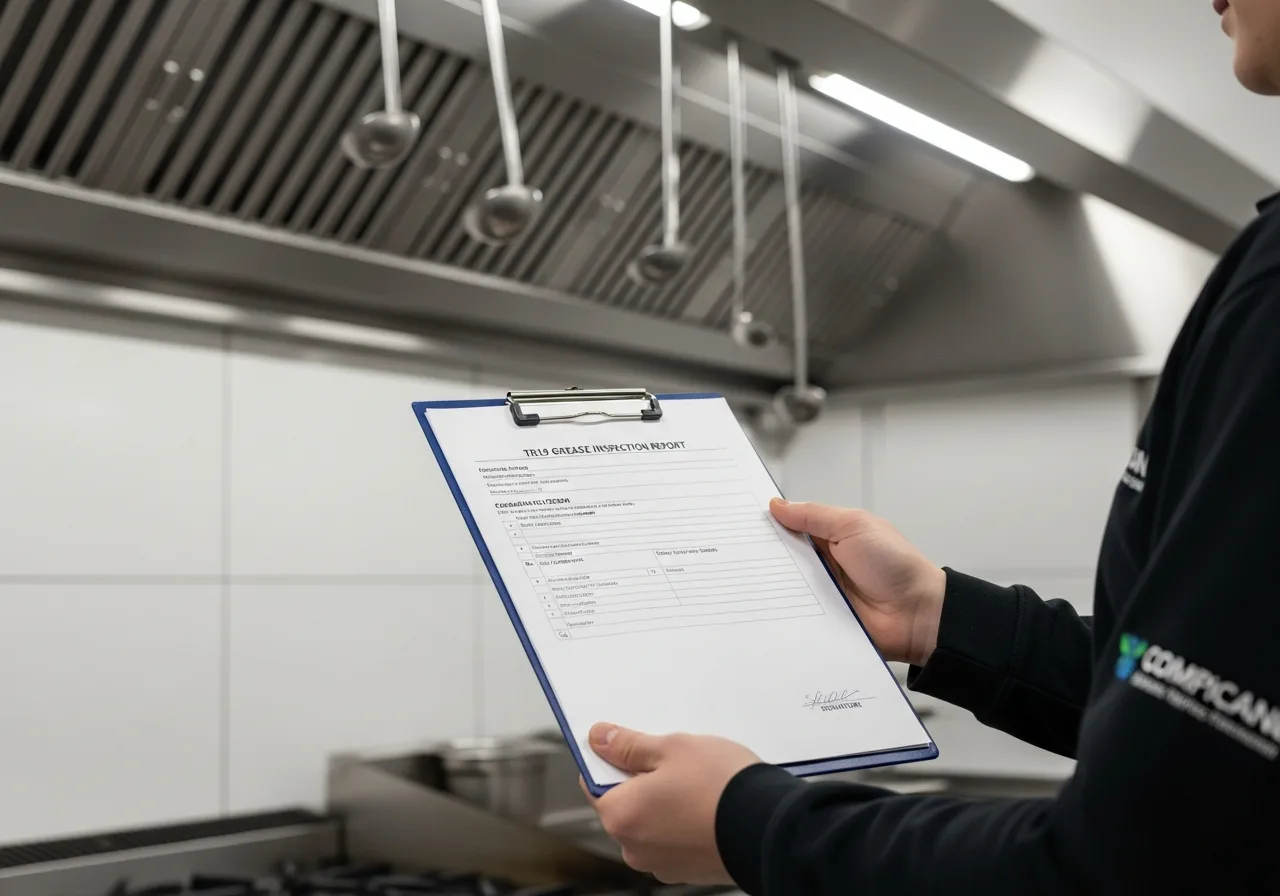
A TR19 certificate is the document a specialist contractor issues after cleaning a commercial kitchen extract system in line with TR19 Grease, the specification published by BESA (the Building Engineering Services Association). It is not a licence, a government permit or a legal instrument. It is evidence: a signed statement, backed by measurements and photographs, that a named system was cleaned to a recognised standard on a given date and when it next falls due. Because nothing else proves the condition of ductwork hidden above a ceiling, it has become the single piece of paper that insurers, fire risk assessors and environmental health officers all ask for.
Certificate or report?
The two words are used loosely. Strictly, the certificate is the one-page summary and the post-clean report is the evidence behind it. A certificate without the report is a claim; the report is the proof. Contractors registered with BESCA's Vent Hygiene Elite scheme can generate a scheme certificate through the BESCA portal once the clean is logged, which gives the document third-party backing. Whatever the format, anyone assessing your kitchen will want both pages together, so treat them as one document.
What a compliant certificate must contain
TR19 Grease is specific about what has to be recorded. If any of the rows below are missing, the document will not stand up to a loss adjuster.
| Element | What it should show | Why it matters |
|---|---|---|
| System identification | Site address, each canopy and duct run named, a schematic of the route to discharge | Proves which system was cleaned on a multi-kitchen site |
| Standard applied | TR19 Grease named explicitly, with the usage band assigned | Insurance conditions usually refer to the standard by name |
| Pre-clean grease readings | Wet Film Thickness Test or Deposit Thickness Test results at set points along each section | Shows how far above the 200 µm trigger the system had drifted |
| Post-clean readings | The same points measured again after cleaning | Verifies the clean rather than asserting it |
| Photographs | Before and after images of the canopy, plenum, every access point, the fan and the discharge | The evidence a loss adjuster looks at first |
| Access | Panels used, panels fitted, and any part of the run that could not be reached | Unreached sections are the usual seat of a duct fire |
| Uncleaned sections | Listed with the reason and a recommendation to resolve it | Silence here is the most common failing |
| Next due date | Calculated from the usage band, not a round twelve months | Defines how long the certificate is valid |
| Contractor details | Company, technician competence, insurance, signature and date | Establishes who is accountable for the statement |
Who will ask to see it
- Insurers and loss adjusters. Most commercial kitchen policies carry a condition requiring extract cleaning to TR19 or a recognised equivalent, with records kept. After a fire, the certificate is requested before the claim is assessed; the insurance requirements guide explains the consequences of not having one.
- Environmental health officers. Extract cleanliness forms part of the structure and cleanliness score during a hygiene inspection, and officers routinely ask for the latest report.
- Fire risk assessors and fire and rescue inspecting officers. A fire risk assessment under the Regulatory Reform (Fire Safety) Order 2005 has to consider the extract, and the assessor will want to see how the risk is being managed.
- Landlords and managing agents. Leases increasingly require the tenant to produce the certificate on request, particularly where ductwork passes through other tenancies or a shared riser.
- Franchisors, brand auditors and buyers. Brand standards audits and the due diligence on a business sale both check for it.
How long a TR19 certificate is valid
There is no fixed expiry. The certificate holds good until the next due date written on it, and that date comes from the TR19 Grease frequency table: heavy use of twelve to sixteen cooking hours a day means a clean every three months, moderate use of six to twelve hours means six months, and light use of two to six hours means twelve months. A takeaway therefore needs four certificates a year; a school kitchen may need one. Where an insurer specifies its own interval, the shorter of the two applies. The cleaning frequency guide explains how to place a kitchen that sits between bands.
Common failures
The documents that cause trouble share the same faults. A canopy-only wipe-down described as a TR19 clean on the invoice. No grease readings at all, or a single figure for the whole system. Photographs of a gleaming hood but none of the ductwork or fan. No mention of sections that were not reached, which a loss adjuster reads as an admission. A next-due date twelve months away regardless of cooking hours. And a certificate produced by a general cleaning firm with no ventilation hygiene competence behind it. A document with these gaps can be worse than none, because it creates a false sense of cover.
Getting a certificate for your kitchen
We do not issue certificates ourselves. We arrange the clean through a vetted specialist who covers your area, and the certificate and photo report come from that contractor once the work is verified. If you only need the current condition assessed, an inspection and report can be arranged without a full clean. Tell us your postcode and cooking hours and we will come back with a quote for whichever you need.
Read next: TR19 Certificate Cost · TR19 Regulations · What Is TR19 Grease?
Frequently asked questions
Is a TR19 certificate a legal requirement?
No statute names TR19. The law requires the responsible person to manage fire risk and keep food premises clean and adequately ventilated, and TR19 Grease is the benchmark that insurers, fire risk assessors and environmental health officers use to judge whether that duty has been met. In practice the certificate is the only accepted way to demonstrate it, so the distinction rarely helps anyone who does not have one.
Can I get a TR19 certificate without a full clean?
You can get a TR19 inspection report, which records the grease readings and condition of the system as found. If the readings are below the 200 µm trigger, the report confirms that no clean is currently required. If they are above it, the report will say so, and the certificate of a compliant clean can only be issued once the work has been done and verified.
Who issues the TR19 certificate when I book through Extract Cleaning UK?
The contractor who carries out the clean issues it. We arrange the work and check that the report arrives with readings, photographs and a next-due date, but the statement of compliance is made by the specialist who measured and cleaned the system, because they hold the competence and the insurance behind it.
What happens if my certificate has expired?
Once the next-due date passes, the system is outside the TR19 interval and an insurer may treat the cleaning condition of the policy as breached from that date. Arrange a clean promptly; the new report resets the cycle. If the gap has been long, expect heavier deposits and possibly a higher price, since the contractor will be removing more material.