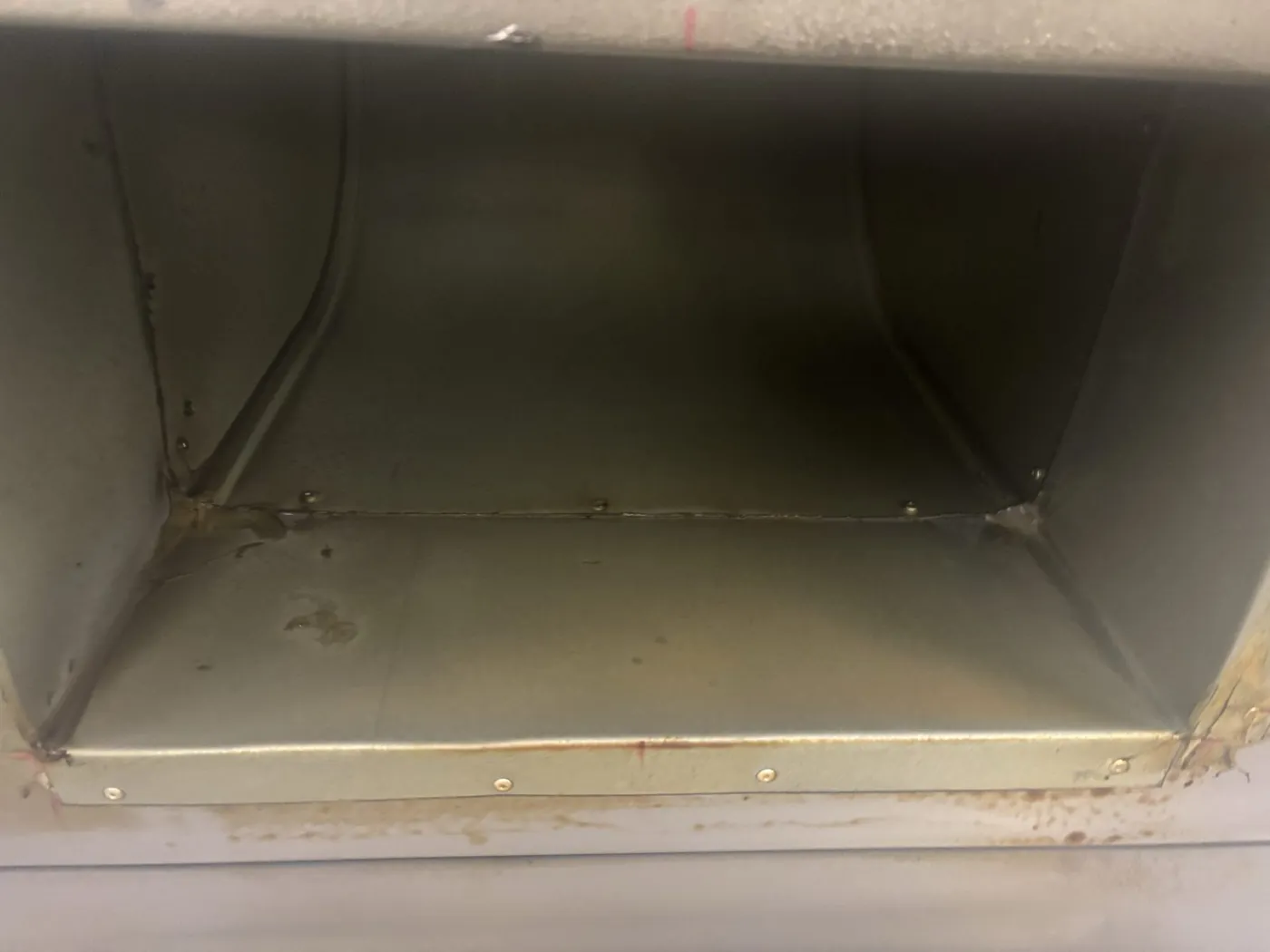
The canopy is the part of the extract system everyone can see, and the part that fills with grease first. Hot air from the range rises into the hood, passes through the baffle or mesh filters, and enters the plenum, the sealed chamber behind the filters that feeds the ductwork. Grease vapour condenses on every surface it touches on the way through. In a busy kitchen the plenum can carry a thick, tacky layer within weeks, and the grease channels and trays that are meant to catch drips end up full of them.
What canopy cleaning involves
A professional canopy clean goes further than the wipe-down your kitchen team does at close of service. The contractor we assign will strip the canopy back to clean metal, inside and out:
- Removal of every filter, tray and grease channel for cleaning or replacement.
- Degreasing of the plenum chamber and the first section of ductwork behind it, where the heaviest condensation occurs.
- Cleaning of the hood interior, the underside and the lip where grease drips form, and the external faces and stainless finish.
- Attention to lighting units, sensors and any fire-suppression nozzles, which need to be clear of grease to work properly.
- Grease-depth measurement before and after, using a Wet Film Thickness Test, so the result is recorded rather than assumed.
The work is done with food-safe degreasers, and the cooking equipment beneath the canopy is sheeted off. The contractor will usually want the range cold, so canopy cleans are booked after service or before prep starts.
Canopy-only or full system?
It is worth being clear about what a canopy clean does and does not give you. If the ductwork and fan were cleaned recently and the canopy simply needs bringing back to standard between full cleans, a canopy-only visit is a sensible piece of maintenance. What it does not do is produce a TR19 certificate. TR19 Grease applies to the entire extract system, from hood to discharge, and the certificate that insurers and fire officers ask for depends on the ductwork and fan having been cleaned and measured too. If it has been longer than the recommended interval since the last full clean, ask for kitchen extract cleaning instead; the canopy is included within it.
| Task | Who does it | How often |
|---|---|---|
| Wipe down hood exterior and lip | Kitchen staff | Daily |
| Wash baffle filters | Kitchen staff or a filter exchange service | Weekly, or daily under heavy use |
| Deep clean of hood interior, plenum and trays | Specialist contractor | Between full cleans, or as part of each one |
| Full system clean with certificate | Specialist contractor | Every 3, 6 or 12 months by usage |
How often the canopy needs professional attention
The TR19 usage bands apply. A kitchen cooking for twelve hours or more a day is heavy use and needs a full clean every three months; six to twelve hours is moderate use at six months; under six hours is light use at twelve. Between those visits, the canopy itself may need a professional deep clean more often in a heavy-use kitchen, because it is the first thing an EHO looks up at during a hygiene inspection and the first thing a loss adjuster photographs after a fire. Our frequency guide helps you decide where your kitchen sits.
What you get afterwards
Every canopy clean we arrange comes with dated photographs of the hood, plenum and filters before and after, and the grease readings taken. When the canopy clean forms part of a full system clean, those photographs sit within the TR19 certificate and report alongside the ductwork and fan evidence. Every contractor in our network is BESA-qualified, CHAS-accredited and fully insured, and hands over the certificate and photo report on completion of a full clean. Keep the report with your fire risk assessment; insurers may ask for it at renewal as well as after a claim, as explained in the insurance guide.
Arranging a canopy clean
We match your kitchen to a contractor who works in your area, whether it is a restaurant with an island canopy, a pub with a wall-mounted hood or a school with a long run of canopies over a servery line. Prices depend on the size and number of canopies, the state they are in and whether the ductwork is included; the cost guide sets out typical ranges. Send us the details through the quote form and we will arrange the visit.
Related services: Kitchen Extract Cleaning · Ductwork Cleaning · Extractor Fan Cleaning · Filter Cleaning and Replacement
Frequently asked questions
Can my kitchen staff clean the canopy themselves?
They can and should keep the visible surfaces and the filters clean as part of the daily close-down, and that routine makes a real difference to how quickly grease builds up. What they cannot safely do is get into the plenum and the duct behind it, or measure the grease depth to record compliance. That is the specialist's job, and it is what the insurer will want evidence of.
Does a canopy clean produce a TR19 certificate?
Not on its own. The certificate confirms that the whole extract system has been cleaned and measured against TR19 Grease, and the ductwork and fan are the parts that matter most for fire risk. A canopy-only visit produces a photo record and grease readings for the canopy, which is useful for hygiene inspections, but for the certificate you need the full system clean.
Will the kitchen be usable the same day?
Yes, in almost every case. The contractor sheets the cooking line, works with the range cold, and leaves the canopy dry and refitted before the next service. Most canopy cleans are scheduled after last orders or before the morning prep shift for exactly this reason, and a single canopy in average condition typically takes a few hours.
My canopy has a fire suppression system fitted. Is that a problem?
No, but the contractor needs to know in advance. Suppression nozzles and fusible links inside the hood are cleaned carefully rather than removed, and the system is usually isolated for the duration of the clean and then re-armed. If the nozzles are heavily greased the contractor may recommend that your suppression company checks them, because a blocked nozzle will not discharge when it is needed.